

How to Predict PACS in 25 Years: A Proven Approach
October 6, 2026 | by Michael Junchaya
If you spend your days deep in DICOM routing, database migrations, and calls about slow viewing clients…pause briefly. The Future of PACS could guide choices.
To guide our work, The Future of PACS shapes how we optimize storage.
Additionally, The Future of PACS shapes how we manage queues and patches.
However, what will the actual foundation of medical imaging look like in The Future of PACS a quarter-century from now?
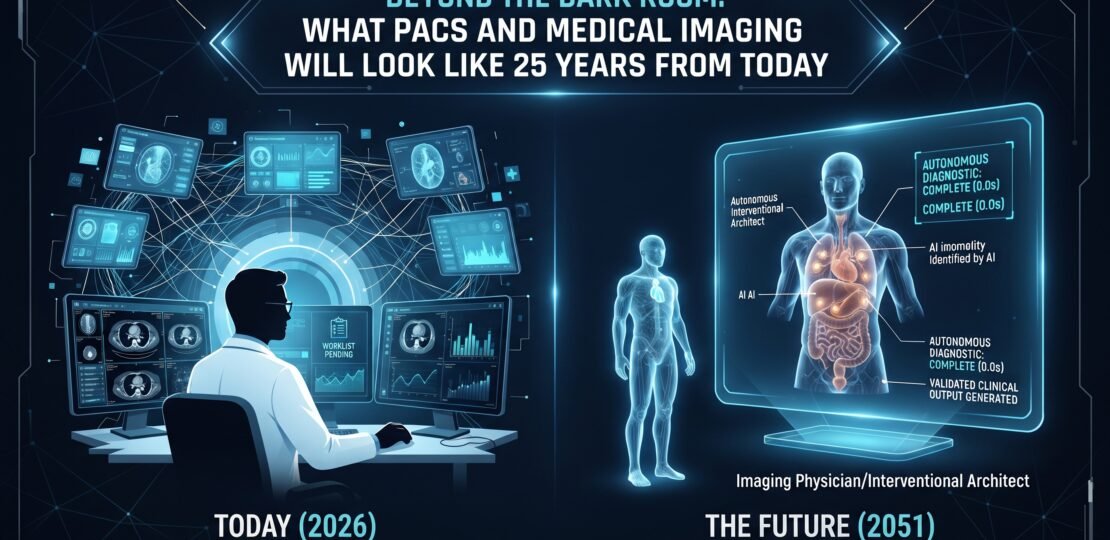
Fast-forward 25 years to 2051, revealing The Future of PACS.
However, The Future of PACS will influence how the healthcare IT ecosystem we navigate today evolves beyond the mainframe era.
Moreover, two big shifts will alter imaging: The Future of PACS includes the collapse of traditional PACS architecture.
Additionally, The Future of PACS will consolidate enterprise imaging platforms under large corporate tech firms.
Let’s break down where this is heading.
The Future of PACS will redefine how we manage image data. Its core components will also be clarified.
Moreover, the traditional role of the reader is on borrowed time.
The Death of PACS and the Rise of the Autonomous Loop
Today, our workflows are defined by hard boundaries.
Moreover, we acquire an image on a modality and route it through an integration engine.
We store it in a VNA or PACS and push a report back through the EHR.
Additionally, The Future of PACS shapes how reports are reviewed.
Additionally, by 2051, the idea of storing and archiving images in a separate database will be outdated.
- The Unified Patient Stream: There won’t be a distinct “PACS” and a separate “EHR” living in different silos. Imaging data will stream natively from the acquisition source straight into an ambient computational core.
- Zero-Footprint Storage: Data persistence will be handled by real-time neural models that instantly extract diagnostic intent, convert pixel data into structured clinical states, and dissolve the need for massive, static DICOM storage arrays. The data won’t just sit there waiting to be retrieved; it will be dynamically processed the microsecond the acquisition completes.
Market Consolidation: The Rise of Mega-Vendors in Imaging IT
We are already watching the early stages of this transformation play out across the healthcare tech landscape.
Additionally, digital health M&A activity is rising, and health systems want easy cross-specialty sharing.
The days of niche, stand-alone PACS vendors are drawing to a close.
The market is consolidating around a few dominant tech titans and platform giants. Moreover, they can swallow up smaller developers.
In time, this trajectory will reach its logical extreme: The Future of PACS.
Health networks will stop juggling disparate cardiology viewers, radiology systems, and vendor-neutral archives. As a result, they will interface with single-source software monopolies.
Consequently, these massive platforms will control everything from modality acquisition pipelines to cloud-native diagnostic synthesis.
However, this hyper-consolidation promises to eliminate interoperability friction and data silos. Nevertheless, it concentrates immense power into the hands of a few infrastructure providers.
Moreover, Instant, Zero-Click Results
Ask any clinician what the biggest bottleneck in patient care is.
Thus, they’ll point right to the reporting queue. Studies sit, worklists pile up, and patients wait hours—sometimes days—for results to post.
Additionally, In the future imaging loop, that queue disappears completely.
Moreover, Results will post instantaneously, entirely self-contained within one unified system.
Additionally, The moment a scan finishes, autonomous diagnostic agents will ingest the multidimensional data stream.
They will analyze tissue structures against global population models.
They will cross-reference the patient’s historical baseline and generate a final clinical output before the patient steps off the table.
Will Radiologists Still Exist in 25 Years?
Back in 2016, pioneering computer scientist Geoffrey Hinton shocked the medical community.
Moreover, he declared that people should stop training radiologists entirely because deep learning would surpass human capability within five years.
Almost ten years after that original window, reality is more complex.
However, rather than wiping out the profession, we face a nationwide radiologist shortage.
Burnout, an aging population, and higher imaging volumes, plus administrative bloat, stretch departments thin and create daily workload crises.
Yet, looking out 25 years, Hinton’s core premise may simply have been early rather than wrong. Moreover, if you define a radiologist by their current job description, that workflow is destined to be 100% automated. Autonomous diagnostic super-intelligence will catch subtle pathologies. Early-stage oncology and complex vascular anomalies require speed and precision that human eyes cannot match.
Does that mean the profession vanishes?
Nevertheless, not entirely, but the profession will undergo a massive metamorphosis.
The traditional image reader will morph into an Interventional Architect or Imaging Physician.
Moreover, instead of hours in a dark room, these specialists will manage edge-case anomalies that baffle algorithms.
They will direct high-end image-guided therapeutics and oversee complex multi-modal interrogations.
To the average patient, the experience will feel entirely self-contained.
The scan happens, and the truth is delivered instantly.
Navigating the Transition to Total Autonomy
Moving from the architecture we rely on today to a completely self-contained, automated ecosystem won’t happen overnight. We are already seeing early glimpses of this transition. Moreover, AI algorithms take over routine triage, volume metrics, and initial checklist generation.
Yet bridging the gap between isolated vendor silos and a unified central system will require overcoming data governance hurdles.
Additionally, corporate vendor lock-in and infrastructural overhaul present further challenges.
If healthcare IT evolves past traditional database limits, we must ask tough questions about investments mapped to the coming decades.
As we look toward fully autonomous imaging loops, the road ahead appears challenging.
Additionally, will the biggest roadblocks be technical limits or resistance to traditional reporting queues?
Let’s talk about it in the comments below.
Looking Ahead: The Day Cancer Is Cured
While autonomous loops and AI-driven reporting will change how we process everyday imaging. Additionally, an even bigger paradigm shift is looming on the horizon. We are likely just a few years away from real cures for cancer.
When that day arrives, the ripple effects across healthcare will be seismic.
They will be deeply disruptive for our industry.
Moreover, to understand the magnitude of this shift, we have to look closely at what sustains modern hospital economics.
Additionally, consider the sheer volume of diagnostic scans, baseline biopsies, heavy staging procedures, and serial PET scans.
These items populate our worklists every single day.
Finally, specialized cancer centers and outpatient imaging suites are built entirely around managing, staging, and treating malignant disease.
However, if cancer is effectively cured, what happens to the massive infrastructure dedicated to tracking it? Moreover, the financial reality is stark. Consequently, cancer imaging and therapeutic monitoring drive a large share of hospital operating margins and equipment vendor revenues. If tumor-burden tracking and staging scans drop close to zero overnight, the trillion-dollar oncology enterprise will face an unprecedented collapse. Hospitals will be forced to ask whether they can pivot quickly toward preventive longevity and regenerative medicine. Alternatively, they will face a devastating financial reckoning.
In our next post, we’re tackling a puzzle.
A cure for cancer will upend medical imaging volumes.
It will transform healthcare economics, and force the entire system to reinvent itself.
As we look toward self-driving imaging loops, do you think our biggest roadblocks will be technical limitations?
Or will institutional resistance to letting go of traditional reporting queues be the bigger hurdle?
Share your thoughts in the comments below.
RELATED POSTS
View all


How to Conduct a PACS Security Audit and Use the PACS Security Audit Checklist Generator
January 23, 2025 | by Michael Junchaya